

Abundant Housing Illinois-backed housing affordability policies are hugely popular
Illinois voters overwhelmingly support the zoning and building code reforms that Abundant Housing Illinois (AHIL) endorses to improve housing affordability in Illinois, even if it means less power for local governments or changing neighborhoods
According to a YouGov poll commissioned by YIMBY Illinois released in March, 84 percent of respondents think the cost of housing is a “major problem” and 82 percent agreed that the state legislature should move to address the high cost of housing in our state, which is exactly what the BUILD plan proposes to do.
Governor Pritzker and leaders in the Illinois General Assembly have proposed six bills to allow more housing construction by changing the local regulations that block new homes and increase their development costs. Based on results from cities and states that passed similar bills, BUILD will have the biggest effect on reducing housing costs when passed collectively.
Illinois voters favor state action
Voters disagree that their local leaders have good measures to keep housing affordable; only 15 percent rated them as “very good” or “good”, while 40 percent rated them as “poor” or “very poor”. To address the high cost of homes, Illinoisans support building more homes over maintaining local government control; 65 percent stated that they favor building more homes compared to “prioritizing preserving local government control”.
And, there is broad support for allowing more homes across community types:
- The belief that the high cost of housing is a “major problem” was shared nearly equally across rural (49 percent), suburban (46 percent), and urban (49 percent) respondents.
- Preempting local government control in favor of more homes has a lot of support; 56 percent of rural voters, 64 percent of suburban voters, and 70 percent of urban voters stated that housing affordability should take precedence over local control.
Even in the face of neighborhood change, voters support building more homes. When asked whether they support “build more homes” or “protect neighborhood from change” 61 percent stated that building more homes was more important than maintaining neighborhood character. This support was held across rural (59 percent), suburban (58 percent), and urban (67 percent) voters.
These survey results paint an exciting picture: Illinois voters are broadly in favor of the state reforming laws to allow more homes and they favor those new homes in their own existing neighborhoods.
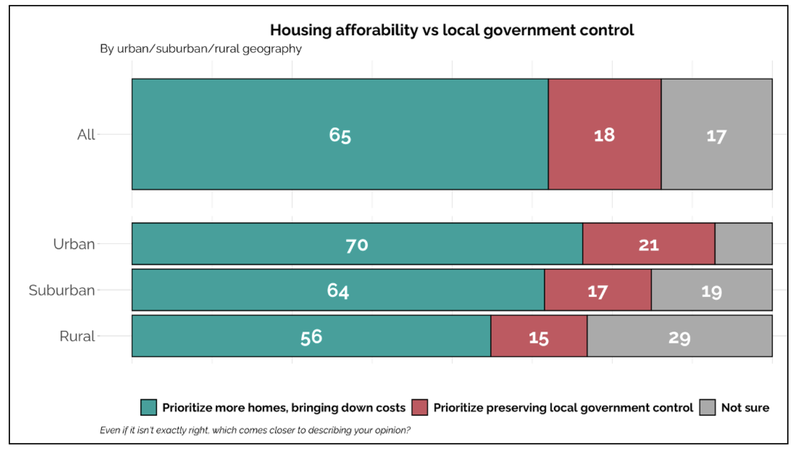
Image caption: Survey results for the question about prioritizing allowing more homes to bring down costs or prioritizing local government control.
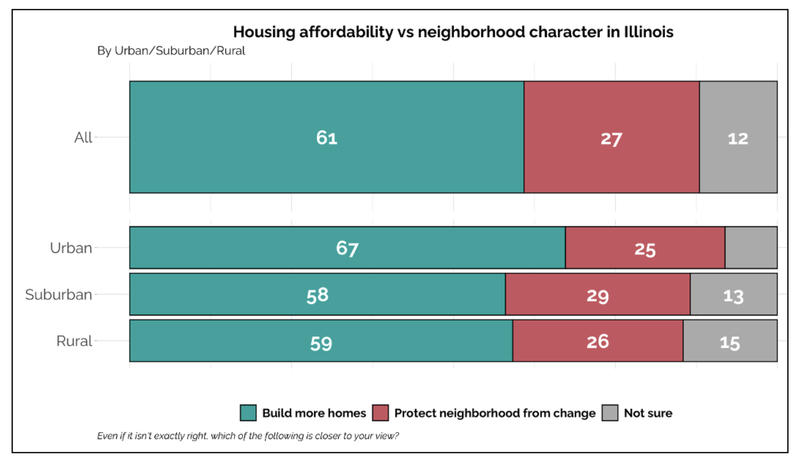
Image caption: Survey results for the question about prioritizing building more homes or protecting neighborhoods from change.
Illinoisans favor a broad set of pro-housing policies
In addition to widely agreeing that there is a housing affordability problem, that the state should step in to address it, and that the fixes should take precedence over local control and character, Illinois voters also broadly support the solutions proposed in the BUILD Plan and Faith-Based Housing acts. The quick summary is that BUILD would legalize ADUs and houses with 2 to 8 dwelling units (depending on lot size), end many expensive parking mandates, speed up building permit approvals, and end the dual stair mandate for smaller residential buildings.
Voters acknowledged in the poll that it is time to tackle traditional zoning’s separation of homes from the amenities people need to live a fulfilling life.
- There was strong support for making it easier to build near businesses/shopping (81 percent) and more homes near bus stops/light rail (67 percent).
- Illinoisans also strongly support allowing faith institutions to build housing (74 percent). Also called “Yes in God’s Backyard” (YIGBY), this legislation would allow faith based organizations to develop land they own into housing to fulfill their missions of providing support to those in need.
- Seventy-nine percent supported the common sense reform “require clear objective standards for building permits”.
Illinois voters also believe that not every home needs to be the same, and support:
- smaller home sizes (69 percent of voters supported this policy)
- homes on smaller lots (66 percent)
- additional dwelling units (63 percent)
- triplexes/quadplexes (56 percent)
This diversity of housing types is essential for allowing seniors to age within their communities, for young families to get established, and for existing homeowners to offset the costs of a mortgage and property taxes.
The survey shows that Illinois voters are ready to accept the many solutions necessary to address housing affordability. The shortage of homes was not created by any one rule, and Illinoisans support adding many tools to the solution toolkit.
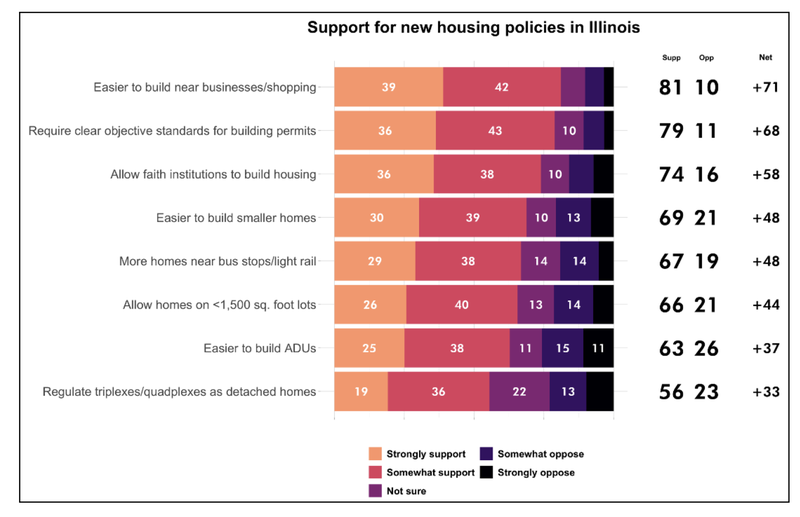
Image caption: The chart shows support for various policies that allow more homes to be built.
Notably, Illinois voters are also widely in favor of reforming dual stair mandates. When asked whether they support “allowing engineers/architects to choose one or two stairways”, 68 percent responded in favor. Single stair buildings have an extensive safety record around the country, and when built with the proper safety engineering they are as safe as, or safer than, two stairwell buildings. Having a single stair instead of two connected by a long hallway allows for more family friendly homes and for the construction of buildings that better fit on smaller lots.
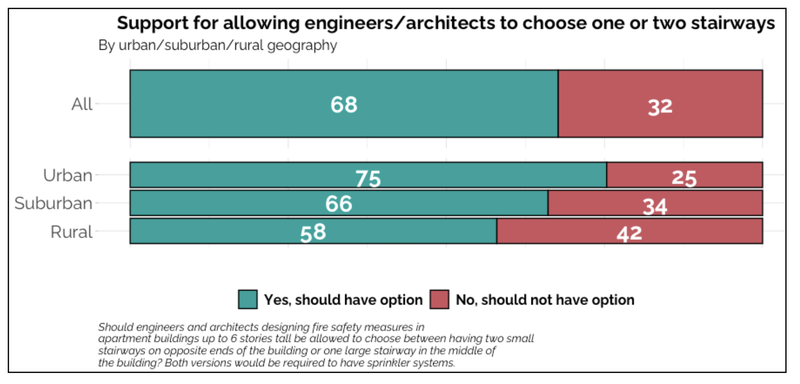
Image caption: Chart showing support for flexibility with dual stair mandates.
Support for pro-housing reforms is bipartisan
The popularity of zoning and building code reforms to improve housing affordability in Illinois, including more technical policy ideas, crosses traditional left/right and urban/suburban/rural political divides. Housing affordability is a massive winner right now in Illinois politics.
Self-identified Democrats, Republicans, and Independents polled favorably regarding every part of the BUILD plan and YIGBY housing measure proposed in Springfield this year. While there are many policy solutions to major issues in American and state politics that poll with drastic difference depending on partisanship, improving housing affordability unites across political lines like few other issues in the state.
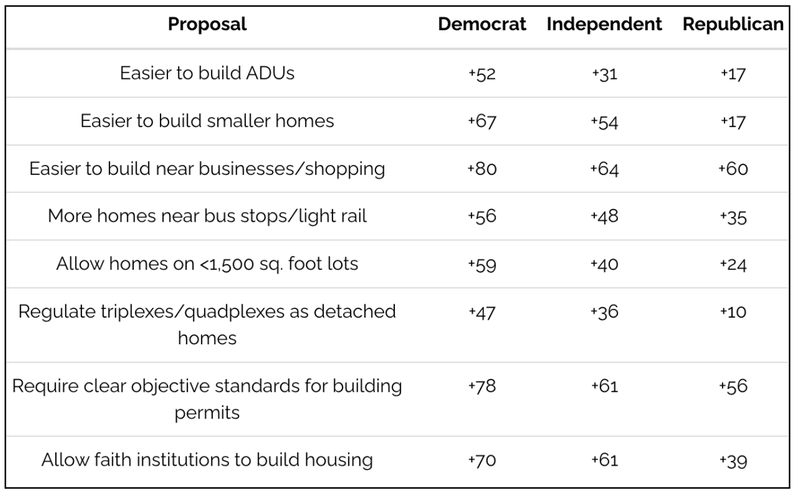
Image caption: Chart showing multi-partisan support for myriad housing policies that the state should enable.
As seen in the polling crosstabs above, a broad coalition exists for pro-housing policies in our state regardless of partisan lean. State legislators have a historic and uniting opportunity to get on board with this pro-housing groundswell of popularity to bring housing prosperity to our state. Let’s build up Illinois!